
- Course Notes »
- Physics »
- Linear Motion
Linear Motion
19/10/2010
Terminology and SI (Standard International) Units
| Distance | metres (m) |
| Displacement | metres (m) |
| Speed | metres per second (m/s or ms-1) |
| Velocity | metres per second (m/s or ms-1) |
| Acceleration | metres per second per second (m/s/s, m/s2 or ms-2) |
| Time | seconds (s) |
Speed and Velocity
| Speed = | distance | m/s or ms-1 |
time |
Displacement-Time graphs
- Displacement (distance) goes on the vertical axis
- Time goes along the horizontal axis
-
The gradient of the line is:
change in displacement = velocity
time taken - A straight line indicates constant velocity
- A curved line indicates a change in velocity so the object is accelerating
- The steeper the gradient, the greater the velocity
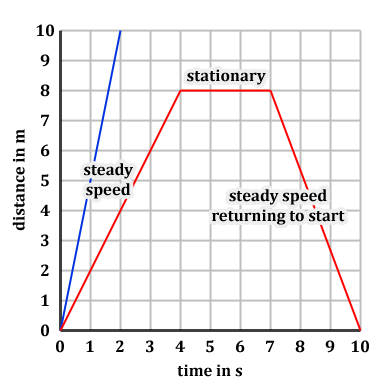
Using the graph
| the total displacement | = average velocity |
the total time |
| the total distance | = average speed |
the total time |
- Horizontal lines mean no change in displacement, i.e. the object is stationary
- A positive slope means the object is moving away from its starting point
- A negative slope means the object is moving closer to its starting point
Velocity-Time graphs
- Velocity goes on the vertical axis
- Time goes along the horizontal axis
-
The gradient of the line is:
change in velocity = acceleration
time taken - A straight line indicates constant (uniform) acceleration
- A curved line indicates a non-uniform acceleration
- The steeper the gradient, the greater the acceleration
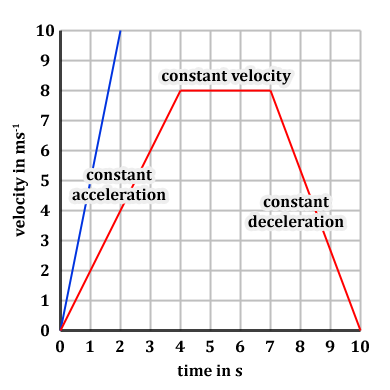
Using the graph
- Horizontal lines mean no change in velocity, i.e. the object is not accelerating
- A positive slope means the object is accelerating
- A negative slope means the object is decelerating
- The area under the graph gives the displacement (distance)
- If the graph goes below the horizontal axis it shows motion in the opposite direction

"S.U.V.A.T" Mnemonic
| Displacement: | s | |
| Initial velocity: | u | |
| Final velocity: | v | |
| Acceleration: | a | |
| Time: | t |
Useful equations
These equations can only be used if the acceleration is constant
| s = | ½(u + v)t |
| s = | ut + ½at2 |
If 'u' is not given, it is most often assumed to be 0ms-1
| v = | u + at |
| v2 = | u2 + 2as |
Click here to show a further 14 rearranged versions of the above equations
Rearranged Equations
| s = | v2 - u2 |
2a |
| s = | vt - ½at2 |
| u = | v - at |
| u2 = | v2 - 2as |
| u = | 2s | - v |
t |
| u = | s | - ½at |
t |
| v = | u + at |
| v2 = | u2 + 2as |
| v = | 2s | - u |
t |
| v = | s | + ½at |
t |
| a = | v2 - u2 |
2s |
| a = | v - u |
t |
| a = 2 | ( | s - ut | ) |
t2 |
| a = 2 | ( | vt - s | ) |
t2 |
| t = | 2s |
u + v |
| t = | v - u |
a |
Questions
-
A cheetah starts from rest and accelerates at 2.0ms-2
due east for 10s. Calculate:
- the cheetah's final velocity
- s = ?
- u = 0ms-1
- v = ?
- a = 2ms-2
- t = 10s
- v = u + at
- v = 0 + (2 x 10)
- v = 20
- the distance the cheetah covers in this 10s
- s = ?
- u = 0ms-1
- v = 20ms-1
- a = 2ms-2
- t = 10s
- s = ut + ½at2
- s = (0 x 10) + (½ x 2 x 100)
- s = 100
Answer: final velocity = 20ms-1Always use the formula that uses the most given values.
Answer: distance covered = 100m -
An athlete accelerates out of her blocks at 5.0ms-2.
- How long does it take her to run the first 10m?
- s = 10m
- u = 0ms-1
- v = ?
- a = 5ms-2
- t = ?
- First work out v using v2 = u2 + 2as
- v2 = 0 + (2 x 5 x 10)
- v2 = 100
- v = 10
-
Then t = v - u
a - t = 2
- What is her velocity at this point?
- s = 10m
- u = 0ms-1
- v = ?
- a = 5ms-2
- t = 2s
- v2 = u2 + 2as
- v2 = 0 + (2 x 5 x 10)
- v2 = 100
- v = 10
Answer: Time taken = 2s
Answer: Final velocity = 10ms-1 -
A bicycle's brakes can produce a deceleration of 2.5ms-2.
How far will the bicycle travel before stopping, if it is moving at 10ms-1 when the brakes are applied?
Converting the given deceleration value to an acceleration value of -2.5ms-2 will be worth a mark in an exam.- s = ?
- u = 10ms-1
- v = 0ms-1
- a = -2.5ms-2
- t = ?
- Rearrange v2 = u2 + 2as to solve for s
-
s = v2 - u2
2a -
s = -100
-5 - s = 20
Answer: Stopping distance = 20m
Physics Books in the Library
You can find these on the library's website by searching the ISBN.
- Introductory Physics by Jerold Touger
- ISBN 0471940003

- Effective Communication for Science and Technology
- (Palgrave Study Guide)
- ISBN 0333775465

- The Sciences Good Study Guide
- ISBN 0749234113
Comments